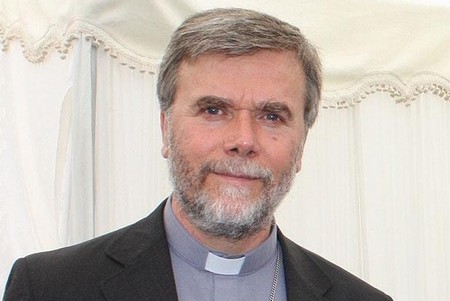
“My primary preoccupation as a Christian and as a priest is to do theology, and that is not the Gospel,” Peruvian Dominican and liberation theology pioneer, Gustavo Gutierrez, has said in a recent interview in Periodista Digital.
“Theology is a second act, that reflects precisely on the life of Christians in the light of the Gospel message,” he explained. “That is my main preoccupation. During my whole life, I have been a priest in a parish, a chaplain to movements so, certainly, I love theology and doing theology.
“I think it is very important to stay close to pastoral work. However, in the case of my country, the pastoral is very circumscribed.
“I never taught in a Faculty of Theology, but, now, at more than 70 years of age, I started to teach in a faculty. A bit late. Earlier, I was developing pastoral work and reflection, writing a great deal.
“I love theology and I see it as an expression of hope. In my view, it is a hermeneutic of hope and will continue to be so.
“This involves the question of the signs of the times since all theology must be looked at in the context of life in the present moment. Naturally, the foundation, the basis, is the Christian message but how it should be lived today depends on the conditions,” Fr Gutierrez said.
Asked to explain the see-judge-act method, he replied that it means “looking at history”.
“See means seeing reality, not speculating that ‘this would be good’. It is linked to the expression ‘signs of the times’.
“One must discern the facts, the causes, why certain effects occur. Then comes the time to judge,” he continued.
“And the final thing – in other words, the reason for seeing and judging – is to act.
“It doesn’t mean writing a book about the issues. It means the fact of committing myself in the face of that fact.
“It’s very simple, created as a method in Belgium and France during the 1920s. It started with the Belgian priest [Joseph] Cardijn, who years later became a cardinal.
“Judging is read the facts, based on the demands of the Gospel. Acting has a more modest tone, it asks ‘what can we do?’ Some people can do this, while others may do something else. So a variety of actions are possible. That is also reality.
The Latin American Bishops Conferences (CELAM) also used the see-judge-act at their conferences in Medellín, Puebla, Santo Domingo and Aparecida. It is a methodology,” he concluded.
SOURCE
FULL INTERVIEW NOW AVAILABLE IN ENGLISH
http://iglesiadescalza.blogspot.fr/2016/02/gustavo-gutierrez-assesses-current.html
PHOTO CREDIT
Periodista Digital