This year is the tenth anniversary of the death of Malaysian activist and former YCW leader, Irene Fernandez.
After working for the Malaysian YCW and becoming a member of the International YCW International Team during the 1970s, she became involved in trade union and human rights work, working particularly with exploited migrant women.
During the 1980s together with her sister Aegile, she co-founded the Malaysia NGO, Tenaganita.
After she criticised the Malaysian government over the deaths of detained migrant workers, she was tried on charges of “maliciously publishing false news.” After the longest trial in Malaysian history, she was convicted and sentenced to one year in prison, but freed on appeal.
The iHeard podcast series remembers her in this week’s broadcast. Click on the link below to listen:
Today marks the 25th anniversary of former South African President Nelson Mandela’s opening speech at the World Council of the International YCW held in South Africa in November 1995.
Mandela, who clearly knew of and appreciated the work of the South Africa, made a point of attending the opening, flying by helicopter to Oukasie, a town 45km from Pretoria, where the event took place.
Seeing the young workers gathered in the hot sun, he left the sheltered stand from where he delivered his speech to individually shake the hand of every delegate to the World Council.
“It is indeed a great privilege for me to be present at the Official Opening Ceremony of the YCW World Council,” the South African president told delegates. “It is a special pleasure to associate myself with the Young Christian Workers` long record of standing up against injustice throughout the world, including South Africa.
“Your decision to hold your Council here in the small and poverty-stricken community of Oukasie speaks louder than mere words. Once more you are demonstrating in a practical way that a true commitment to justice demands more than good intentions and fine speeches. It calls for a full association with those who are struggling for justice.
“Oukasie became a symbol of the power of community resistance assisted by international solidarity. Eventually the apartheid regime retreated and the people of Oukasie were victorious… “I recall this history because it speaks of everything that Young Christian Workers stand for,” Mandela concluded.
Fr Joe Falkiner
Former YCW chaplain, Fr Joe Falkiner o.p. also recalls the event in his forthcoming memoir:
“I was able to attend the Opening Ceremony. It was held on the sports field of an even poorer township named Oukasie. ‘Oukasie’: the “Old location” attached to the recently industrialized city of Brits. Rather a mere squatter camp, made of makeshift shelters built on top of one another: no tar-roads, no sewerage, the old toilet-bucket system, twenty water-taps for its twelve thousands or so residents. It had escaped the huge black townships’ removal campaign of the sixties. But that had lasted for too long for the State and by the late seventies, time had come for it to go – and for its residents to be removed somewhere, over the border of the so-called ‘independent state’ of Bophuthatswana newly recognized by South Africa.
“Against all expectations a YCW group had started and developed in Oukasie. Through all sorts of harassments, dismissals, police brutalities, detentions, court cases, and even bombings by night of some of its leaders’ houses – in which one of them lost his wife – it had managed to launch and develop a strong Trade Union branch and a vibrant network of civil associations surrounded by a large national and international support: ‘We shall not be moved!’ did they claim. And the state had to back down. By the nineties Oukasie, after having been ‘de-proclaimed,’ was finally ‘re-proclaimed’ as a location. That is where the South African YCW had decided to host and hold the opening ceremony of IYCW International Council.
‘The highlight was a welcoming speech by the state president himself, Nelson Mandela. For this the football field was divided into by a rope. The residents of the township gathered on one side, and all the YCW’s on the other. There was a space between them and into that space landed the helicopter carrying Mandela and his people.
‘Mandela first walked along the rope shaking hands with the front row of township people, then came across to the YCW’s. On this side there was a small roofed grandstand and I happened to be sitting in it keeping out of the sun as it was a very hot day. Mandela and his staff came up and sat just in front of me. There were no YCW’s in this grandstand — they were sitting on a much smaller grandstand, open to the sun. I tapped the shoulder of the official sitting in front of me and pointed this out to him. He immediately told Mandela where the international delegations were to be found. Mandela jumped up, went across to the other grandstand, and shook hands with each person there. He then came back to the roofed grandstand to make his speech,” Fr Joe recalls.
The complete story of the YCW in Oukasie has also been well told by Kally Forrest in her book, Lessons from a township that resisted apartheid.
Through his communication of the 17th October 2017, Cardinal Secretary of State Pietro Parolin conveys the message of Pope Francis to ICYCW, IYCW and CCI.
In this message, Pope Francis appreciates the devoted sentiments that prompted us to write to him about the important work of those young people who continue to be inspired by the work of Joseph Cardinal Cardijn.
The Secretary of State conveys that the ‘Holy Father wishes to renew his prayerful wishes to the young people the three organisations represent and that he invokes upon all of us God’s blessings of joy and peace’.
Pope Francis’s message is in response to a joint statement made by CCI, ICYCW and IYCW on the occasion of the 60th anniversary of IYCW Rome Pilgrimage 1957.
In the joint statement, while recalling the current situation of the young workers around the world, we had stated that Cardijn always insisted on the importance of the vocation and mission of each young worker in his or her daily life.
We had also mentioned that we believe that this message is particularly relevant and important in the light of next year’s Synod focusing on Young People, the Faith and Vocational.
Cardijn Community International thanks IYCW and ICYCW for their willingness in joining the efforts of CCI to issue the joint statement.
Let us continue to promote Cardijn’s spirituality, vision and methodology.
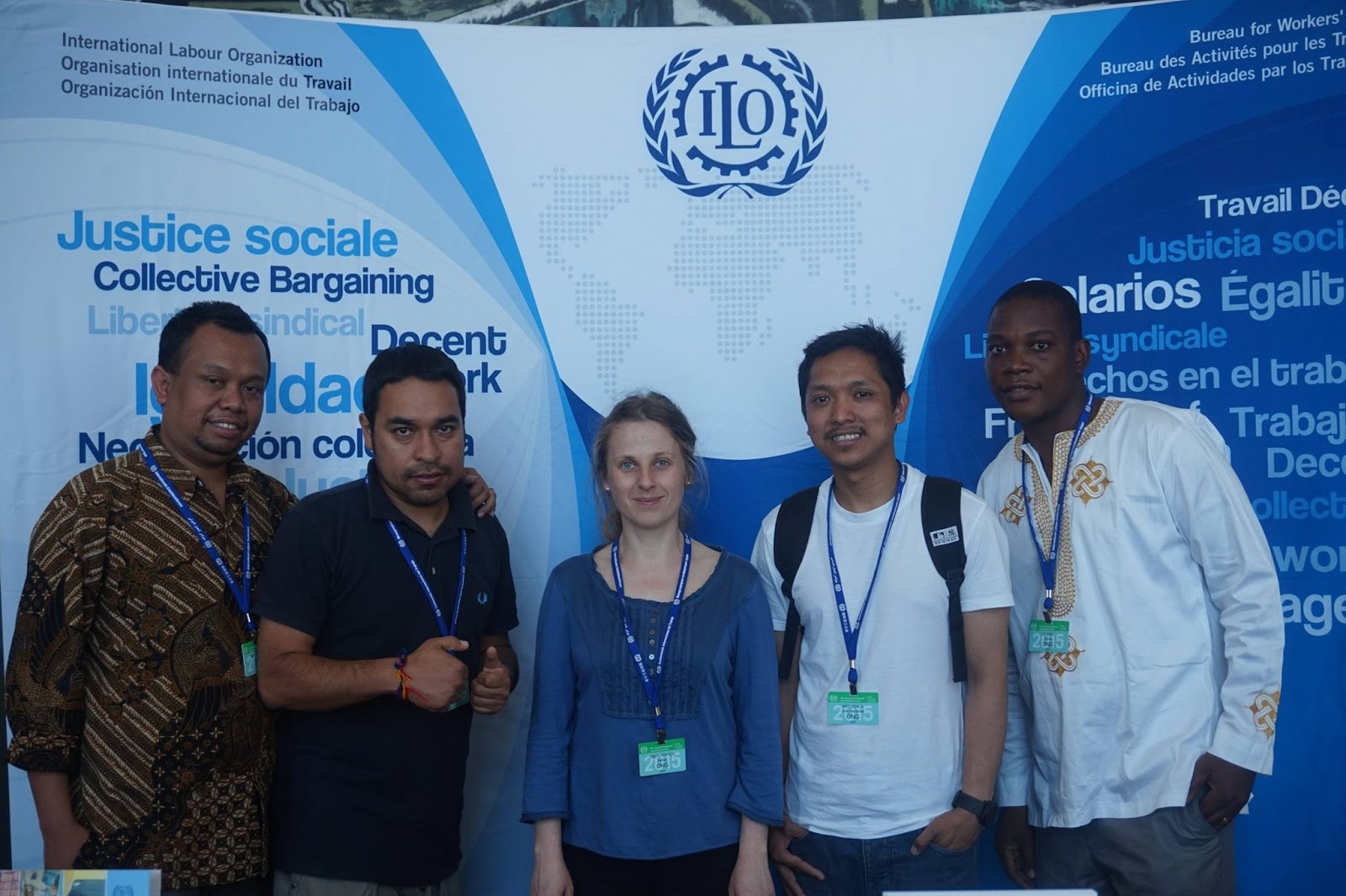
L to R: Ludovicus Mardiyono, Edson Rolandes Flores Morales, Nadiya Oksyutovych, Andy Predicala, James Denteh
The ILO must analyse the transformation of work from agricultural to industrial, to services and now to robotics technology, according to a submission presented to the International Labour Conference (ILC) in Geneva from 1 – June 13, 2015.
This year’s ILC discussed three main topics, namely the transition from the informal to the formal economy, SMEs and decent and sustainable employment and the third is the labour protection policy, which includes wages, maternity policy, working hours and occupational health and safety.
The IYCW delegation actively expressed their political views in all committees. In the informal economic committee and social protection, IYCW highlights some important issues, among others, urged adopted the concept of a living wage for all sectors of work and social protection should be inclusive apply to all types of workers and universally applicable.
Responding to ILO Director-General report on The Future of Work Centenary Initiative, Andy Predicala, International Treasurer of IYCW expressed that the centenary conversation must evaluate deeply the globalization, neo-liberalisation and free-market policy because it does not generate enough jobs but instead it creates multi-crises in the society, and does not warrant fair distribution of wealth. It must also analyse the transformation of work from agricultural to industrial, to services and now to the robotics technology.
The IYCW also urged that social protection coverage must be extended to all workers in the informal sector and all informal workers should be entitled to enjoy all basic rights of workers. ILO Declaration on Universal Labour Protection
IYCW President, Ludovicus Mardiyono, added that labour protection is a global issue and requires a shared responsibility.
“We propose to the ILO to take the political steps to agree upon and immediately sign the ILO Declaration on Universal Labour Protection, and this declaration should be inclusive and universal,” said Ludovicus from Indonesia.
“IYCW along with other Catholic organizations and trade unions continue to voice social justice and peace for all workers in the world,” he concluded.
SOURCE
YCW at the International Labour Conference: Proposing ILO Declaration on Universal Labour Protection (International YCW, Media Release)
Cardijn Joseph Cardijn “was a wonderful listener” who “very seldom spoke”, according to former IYCW Secretary-General Helen Jagoe.
He “never, ever lost his interest in young people” from the time he founded the Young Christian Workers (YCW) to his death in 1967, Helen Jagoe, from Bathurst Australia told the Catholic Weekly.
She joined her local YCW at 18 and quickly rose through its ranks to become national secretary in Melbourne and later general secretary of the movement’s international secretariat in Brussels.
It was there she worked closely Cardinal Cardijn, then in his twilight years but still a “gentle, happy man” and devoted champion of the spiritual well-being of young workers.
“At the very beginning he used to stand outside the factory gates, and he’d see these kids walking out,” she says. The priest had watched children disappear from his congregation as soon as they were old enough to work.
He became concerned as he saw them exit factories, their faces aged with grime and fatigue, and their faith threatened by the crass secularism of industrial culture. “They were lost immediately when they went into the workplace,” Helen says.
To counteract the dehumanising nature of the workplace, he created the See, Judge, Act method, which called on young people to look at the world around them and understand it in the light of the Gospel, then to act accordingly to improve the situation.
He spent hours with young people asking them about their working conditions and job satisfaction, and relayed those messages to bishops around the world and members of the curia.
Unconcerned about Mass attendance or membership of religious societies, he challenged young people to be “apostles in the workplace”.
At its peak the YCW was active in 90 countries, including Australia, where it offered a range of services from employment support and language classes to sporting competitions.
In 1965 Cardinal Cardijn travelled to Australia on a visit that was meaningful not just for YCW members in Australia but also “for the Church”, Helen says.
No less a figure than Pope Paul VI earlier paid tribute to him at the closing of the Second Vatican Council when he noted “the good seed planted 50 years by several generous pioneers and particularly a young Belgian priest had truly yielded a hundredfold”.
Cardinal Cardijn’s death just two years later was a great shock for all his supporters, including Helen who was then based in Brussels.
“He was planning a trip to South America when he died. He had a bit of a cold and got the flu, he was in bed, then all of a sudden we heard he’d died of pneumonia.”
Helen was one of five YCW leaders in Brussels entrusted with planning the funeral.
At the time of his death Cardinal Cardijn was internationally recognised for his work with the YCW, and supporters from around the world attended the requiem Mass at the Basilica of the Sacred Heart in the Brussels suburb of Koekelberg.
Though his death at 84 was a shock, “we didn’t miss him, because we knew his legacy so well”, Helen says.
“He was never there as a leader, he was always in the background.
“We went on living his message.”
Almost 50 years later, the movement still exists in Australia, but Helen believes a reform is needed to better appeal to the “frenetic lifestyle” of young people today.
“They never seem to stop to reflect because life doesn’t allow them to,” she says.
“It needs to be re-founded by young people for young people with young people, using the method but perhaps not the name – people today don’t recognise themselves as workers.”
Helen is hopeful the first step towards the canonisation of Cardinal Cardijn will trigger “a renewed interest in what he did – not the man but in his method”.