Former YCS chaplain celebrates 60th anniversary of profession

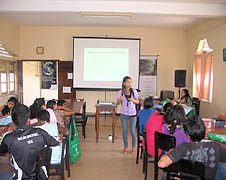
Former YCS chaplain, Salesian Father K.K. Anthony Kariyattil, celebrated the 60th year of his religious profession among Murshidabad’s tribal youth at Azimganj on 25 January 2025.

Known as Kolkata’s youth-fest icon of the 1980s on January 25, Fr Kariyattil is currently the confessor and teacher of Salesian pre-novices and aspirants at Savio Bhavan in Azimganj, Matters India reports.

Some 20 priests and several religious sisters and scores of young people participated in the solemn Mass marking the diamond jubilee of Father Kariyattil becoming a Salesian.

Born in Valapad, Thrissur district of Kerala in 1944, Father Kariattil became a Salesian of Don Bosco in 1964.

As a youth animator in Calcutta in 1974, living in Don Bosco School Park Circus Salesian community, Kariyattil, was engaged in ministry with high school students.

“A youth leader from college days in Salesian College Sonada, I became an animator of Young Christian Students as well as the Leadership Training Service students in Calcutta in 1974,” the 82-year-old priest recalled.

Kariyattil, who was the youth fest director for 13 editions, recalled the first fest held at Don Bosco School Park Circus Calcutta in 1977, initiated by the late Brother Trophy D’Souza, Head of the Department of English at Salesian College Sonada, Darjeeling.

Brother D’Souza organized the event with the help of Salesian College Sonada, Kariyattil was then a teacher and youth animator residing in Don Bosco Park Circus.

After his ordination by Jesuit Cardinal Lawrence Picachy of Calcutta in 1978, Kariyattil was appointed youth commission delegate of the archdiocese and, in 1978, chaplain of YCS Calcutta.

Under Kariyattil’s leadership, Youth Fest Kolkata grew into a mass movement of youth, with zonal events in the four deaneries of the archdiocese culminating in a day-long event at Don Bosco School Park Circus grounds.

It was preceded by catechetical themes with specific social action following Cardijn’s Review of Life method: “See, Judge and Act.”

This method, initiated by Joseph Cardijn, a Belgian priest and founder of the Young Christian Workers movement, encouraged young people to engage in social action by observing their surroundings (See), reflecting on what they observed in light of Christian teachings (Judge), and taking action to address issues.

SOURCE

Youth fest icon celebrates 60 years of service (Matters India)

US social justice pioneer Msgr Marvin Mottet has died

American social justice campaigner, Msgr Marvin Mottet, who was an early member of the US YCS, has died at the age of 86 in Davenport, Iowa, the National Catholic Reporter and Catholic News Service report.

Msgr Mottet,a former executive director of the U.S. bishops’ Catholic Campaign for Human Development, had just reached the 60th anniversary of his ordination.
In a 2012 interview, he noted that the Great Depression had made a great impact on him as had his experience in YCS.

“Well, of course, the Great Depression had a big impact on everybody, just to survive. During those days a lot of Ambrose priests came out of working class families, their dads probably worked in factories and were union organizers and they had that in mind,” he said in an interview with his alma mater, St Ambrose University.

“At least in my experience, whatever class I went to I got social justice. If it was Father Urban ‘Penny’ Ruhl in English literature, you got social justice. If it was philosophy, history, it didn’t matter, you got social justice, so it was always woven in there as a thread running through.

“Also, there was Young Christian Students that Father Bernard Kamerick led. It had weekly meetings and we would also go to Chicago for big YCS meetings.
“As students we got to meet all these priests in Chicago involved in race and justice and inner city issues. And my first year here, Ambrose hosted the National Catholic Social Action Conference. 
“They called off classes for a day or two and all the students were invited to go. We got to meet all these outstanding people and hear all their talks,” he recalled.
Later he often to the Cardijn observe-judge-act methodology that he had learnt, as Katy Strzepek, director of St Ambrose’s Women’s Studies program noted.

“I think so, too. I loved it when I heard your talk at the civil rights event, Msgr. Mottet, about Father Joseph Cardijn’s method of observe-judge-act, because that is so much of what I try to teach my students to do in my class,” she told Msgr Mottet in her interview with him.

In another tribute, Bishop Martin Amos observed that in his 10 years as bishop of the Davenport diocese, “I’ve come to realize the tremendous impact Msgr. Mottet has had on people in general, the poor in particular and in the area of social justice.”
A farm boy from Ottumwa, Iowa, who witnessed his parents’ compassion toward anyone in need, young Marv Mottet honed his social justice skills as a student at St. Ambrose College, and later as a priest and teacher in the Davenport diocese and as executive director of the U.S. bishops’ domestic anti-poverty program, now called the Catholic Campaign for Human Development in Washington, from 1978 to 1985, NCR reports.

He embraced diversity, working side by side with African-Americans and with Hispanics to end discriminatory practices in housing, employment and immigration. Ordained to the priesthood at Sacred Heart Cathedral in Davenport in 1956, he helped form the Catholic Interracial Council to address racial discrimination and segregation in the city a year later.

At age 78, he marched in a rally in Postville, Iowa, on behalf of immigrants in the country without legal permission who were devastated by a massive immigration raid on the town’s meatpacking plant. He later brought Martin Luther King Jr and Mother Teresa to Davenport to receive the Pacem in Terris Peace and Freedom Award. Years later, he himself received the same award.

In 1969, he launched the Social Action Department for the Diocese of Davenport.
“A Pacem in Terris Coalition member likened (Msgr Mottet’s influence) to the role of yeast in bread-making. It has an invisible but undeniable effect,” NCR says.
Organizations such as Legal Aid, Center for Active Seniors Inc., Quad-Cities Interfaith, Interfaith Housing, Project Renewal, Cafe on Vine and other programs began or benefited from the leavening efforts of Mottet and his collaborators.

CCI launched in Hyderabad India

Cardijn Community International (CCI) was formally launched in Hyderabad, the capital of Andhra Pradesh in India on 19 February 2012.

Hyderabad is the fourth most populous city in India with an area of 650 sq k.ms (250 sq miles). Hyderabad is also a major global centre for IT and bio-pharmaceutical industries.

Around 50 former leaders of YCS, YCW and CWM participated in the one day launch program which started with a mass by Fr. Thumma Arla, a former animator of YCS and the Director of the Diocesan Pastoral Centre. The Diocesan President of CWM and the Diocesan Youth Director, Fr. Fatima Reddy also attended.

Ms Elizabeth Martin, a former YCW welcomed the gathering and introduced the CCI National Leaders and the International Secretary General.

CCI was formally launched by lighting the lamp by Fr. Thumma Arla and other CCI leaders present.
James Sylvester, a former YCS leader and currently member of the CCI-India Volunteer Team steered the day’s program.

Fr. Thumma Arla assured his support in the efforts to promote Cardijn. He emphasized on the need to ‘See-Judge-Act’ in the light of the Gospel values. Fr. Thumma appealed to the CCI to help him re-activate the Pastoral Centre and put it to proper use and expressed that CCI is always welcome to make use of the Centre.

Xavier Anthony, CCI National President extended the greetings on behalf of the National Team.
Ms Glynis Joseph, National Secretary stressed on the need for clear financial perspectives and self-financing.

Clifford Bastian, Member of the CCI-India National Team, who is also a former YCW of Hyderabad recalled his days in the YCW here and wished the Hyderabad CCI all the best.

M. J. Ruben, CCI Secretary General congratulated the Hyderabad Chapter for the launch. In his brief intervention he covered on the origin and objective of CCI and gave a general view of the functioning of the movement at the international level.

All the former leaders were very excited to meet each other after 20 to 30 years and they were very jubilant that such an opportunity was created by CCI.

There was a feeling of emotion clubbed with gratitude to the Cardijn movements which formed them. In their personal testimony, all those who spoke acknowledged that ‘they are what they are today only because of the formation they received through the Cardijn movements’.

The forenoon session ended with lunch.

Thirty-five members enthusiastically attended the post lunch planning session in which the members continued their testimonies.

Two factors emerged very clearly from the testimonies, i.e. i) Cardijn is the binding factor among all of them; and ii) through the formation in Cardijn movements, they have a ‘special identity’ which is opposed to the ‘identity’ imposed by the consumer culture promoted by globalisation.

All of them felt that there is a need to continue to work to restore human dignity and that they should function as a group. All of them wanted to be part of the CCI.

At the concluding session, James Sylvester proposed formation of an ad-hoc team to work out modalities for regular meetings, activities, etc. and it was agreed.

After consultation in small groups, a seven member team was nominated as the Coordinating Team of CCI-Hyderabad with Ms Elizabeth Martin as the Coordinator; the members of the team are: James Sylvester, I. Prakasham, Martin Michael, Patrick Fernandez, Manasa Janaki and John.

An appeal was made to those who would like to be part of the team to contact the Coordinator and to take part in the next meeting.

The grand launch program followed hectic preparations and contact work done by James Sylvester, Martin Michael and Ms Elizabeth Martin.

The National leaders of CCI-India and the CCI Secretary-General appreciate and congratulate the efforts of the organising team in bringing Hyderabad into CCI fold.

Report: MJ Ruben, CCI Secretary-General

Sth African YCS recalls 1976 anti-apartheid protests

South African YCS leaders marched in a June 16 procession for Africa Child Day commemorating the beginnings of the Soweto Uprising against the former apartheid regime in 1976.

The students were attending a one-week annual conference in Mohale’s Hoek high school, Transformation Resource Centre reports.

The procession where the youth carried placards and sang different songs, began at Mohale’s Hoek high school via Likhutlong, Thoteng and Moeaneng villages, St Stephen’s high school to the main street and back to the starting point where speeches were made.

Speaking at the event, the District Administration Manager, Diteboho Monese, said the day calls on the youth to take initiative to effect changes in issues that concern them.

He said, now the country is heading towards Local Government elections, the youth are expected to fully participate in such activity, while at the same time ensure that their aspirations are incorporated in the national development plan.

YCS President, Ramothamo ‘Nyane, said South Africa gained freedom through influence by the youth learners, adding that youth learners in Lesotho can effect change as well in the country.

He said the day’s commemoration is held in support and cognisance to struggle acts against apartheid by South African youth in June 16 1976. ‘Nyane called on the youth to stand up in arms against corruption to eradicate poverty as a number one Millenium Development Goal (MDG), which he said when not addressed, it would be difficult to achieve other goals.

He commended the government for progress made towards achieving universal primary education though he expressed concern about what will happen beyond primary level. The President of Lesotho Youth Federation (LYFE), Nts’ekhe Tlaba, said there is still hope that the youth will influence the government to give education cognisance it deserves as a right to every person.

He urged the youth to work as a team to address problems they are faced with and influence that the MDG’s should be attained. The African Child Day is commemorated annually in several African countries on June 16.

SOURCE

Young Christian Students commemorate African Child Day (Transformation Resource Centre)

The insights of the YCW and the See Judge Act

Father Charles Rue recalls the formative influence of the YCW and the See Judge Act method in this article from the Australian Columban magazine.

06.06.2011

I am grateful to the YCW for the insights it has given me and the courageous example of people systematically applying faith to their real life situations.

My first memory of the YCW (Young Christian Workers) was in the 1950s when the curate in our rural parish proposed to us young men who had just left school to establish a local branch. The YCW and the YCS (Students) was the alive Catholic action of the day that applied faith to life. We discussed the idea but decided that we would rather join the local Junior Farmers. That group was seen as Protestant (later proved to be wrong), but we saw it as more related to our lives as budding farmers.

My next encounter was a YCW information camp for seminarians run by Fr Frank Marriott in the 1960s. A vivid memory was hearing the story of a young worker who could not read well. Rather than give him some spiritual book, he was first given a ‘western’. We were informed that there had to be some immediate interest in reading for him. I thought this was a very practical approach.

In South Korea in the 1970’s I was assigned to be chaplain to a YCW group of girls working in a cloth factory. At each meeting they described their life as workers in the factory, reflected on it in the light of faith and then decided on an action to try. They reported back on the action at the next meeting.

See-Judge-Act Method

This is the tried and tested YCW method: See-Judge-Act. They described the lack of heaters in the factory leading to fights among the workers. Their action in ‘turning the other cheek’ was to stand back from the heaters. They reported that they were too cold; the fights continued.

READ THE FULL STORY HERE

The strong influence of YCW (Australian Columbans)

South Asian YCS leaders meet

South Asian YCS leaders have met in Sri Lanka to discuss building a regionwide culture of action to solve climate, food and rights issues.

Some 30 students from India, Pakistan, Bangladesh, Nepal and Sri Lanka attended the 10th International Young Christian Students Movement (YCS) forum, organized by the YCS Sri Lanka branch, in Tewatta, ucanews.com reports.

During the week-long meeting that ended Sunday, students discussed ways to build a culture of action to control global problems of climate change, food crisis and human rights violations.

The YCS international members in over 85 countries are ready for the international challenges and contributions to manage the problems, Reyne Clemena, YCS Asian coordinator told ucanews.com.

“We (students) have a capability to achieve the goal,” said the Filipino girl, as their Church-run movement has 200 members in Pakistan, 4,000 in Sri Lanka, 166 in Nepal, 9,000 in Bangladesh and 175,000 in India, within the South Asian region.

The region has already experienced more fallout from climate change than other continents and it still continues to suffer from threats such as rising sea levels, forest degradation, floods, cyclone and tsunami and food shortage.

At the end of the conference, the YCS members outlined activities for their 2011-2013 action plans. They include tree-planting, poster campaigns, dry foods collection and distribution to the needy, food waste control, school fundraising, demonstrations and awareness programs through seminars, debate and workshops.

Meanwhile, Father Patrick Simon Gomes, executive secretary of the Episcopal Commission for Youth in Bangladesh, said they have taken steps to promote the use of bags, wall mats and calendars made of textiles rather than plastic.

SOURCE

South Asian students take on world problems (ucanews.com)

Sudan YCS ‘martyr’ remembered

Sudanese Archbishop Paolino Lukudu Loro of Juba presided at a Mass last month where he blessed the tomb of late YCS member Abraham Gajuk who was killed in 1992 during a peaceful protest against forcibly imposed Islamic indoctrination.

Archbishop Lukudu urged the Young Christian Student (YCS) to pray for peace in Sudan upon uncertainties surrounding the referendum process.

He told the 27 November gathering at a memorial prayer for YCS founders and members killed during the war to invoke the spirit of the decease members to bring peace to Sudan.

Archbishop Lukudu said Abraham Gajuk and Okela were killed in cold blood in Juba due to their YCS activities.

He prayed to the deceased members of the YCS to intercede for peace in the Sudan and called on the youth to register and vote for the referendum in order to honour the blood of their slain members.

YCS Sudan is currently celebrating its Silver Jubilee in Juba. The long week celebration concludes on Sunday.

There were young people present from most of the dioceses in Sudan, as well as from Uganda and Kenya, Father Herald Joseph Brock CFR noted on his blog.

“The event was organized by our friend, Fr. Martin Ochaya Lino, Secretary General of the Archdiocese of Juba and chaplain and former member of the YCS,” Father Brock wrote.

“I was asked to address the participants on the theme, ‘A Personal Relationship with God.’ The youth were very attentive and responsive.

“The YCS event was co-sponsored by Catholic Relief Services (CRS) with the assistance of another good friend, Tom Purekal, CRS Peace Building Program Coordinator for South Sudan,” Father Brock noted.